25 August 2010

Debriefing

In class today we debriefed from our visit to the concentration camp, attempting to digest and make sense of what we saw. There was a general consensus that nothing new or significant was learned. Rather, another element, a visual layer, was added to our sense of understanding the Holocaust and concentration camps. These continued thoughts from our visit may seem disconnected from one another - similar to how we will always be disconnected to the camps, no matter how hard we try. There is no logic to these thoughts, just as there is no logic to these camps.

Someone saw the following etched onto a wall within the barracks by a former prisoner:

"If there is a God, He must plead for my forgiveness." A perspective we cannot even imagine or attempt to understand.

We discussed the memorials we saw, and how all memorials are political. They honor the victims in words which further that particular nation's political agenda - this is inevitable. They build the victims into a political or national model, whether consciously or subconsciously. Can there be an apolitical monument?

The 2003 plaques (shown on yesterday's blog) commemorating the American liberating forces almost seemed unnecessary. They seem to be the typical American response, glorifying the heros. This place is not about America and its Allied accomplishments, but it is about the victims. The plaques, although nice and appropriate in the correct context, seem violating here. Is there ever a correct context though?

It was stated that to fully grasp the situation of the camps one must oscillate between commemorating the individual and commemorating the mass. Is this the reason for the monuments outside of the camp?

Deaths in Mauthausen were mostly political, thus may it be appropriate to have or erect political monuments here?

Was there any fluidity in viewing and entering the gas chambers? The chambers were full during the war with the victims. Today, the chambers are filled with tourists and us. Is this an ironic fluidity or is this emotional vandalism?

In Ruth Kluger's biography, she protests against visiting these concentration camps, stating that tourism and visiting them only serves to glorify the crimes committed there. However, is there a middle ground, fluctuating between individual stories and guided tours? Is there a similar middle ground between glorifying or punishing the individuals involved in the Holocaust (war generals, surviving SS members) versus glorifying or punishing the mass victims and soldiers?

Is a compromise possible? May visiting under an educational premise with a tour guide be a compromise? When we were there, there were bikers visiting the barracks, children running and screaming, and laughing, families taking pictures, and pure ignorance by the majority of the viewers. Is less foot-traffic and a lessening of the "family-outing" mentality the answer? Who determines the bounds of regulating human behavior?

In regards to the camps, is time a dimension or rather a diminishing factor, lessening the importance and impact of a past history? When studying something, does a visual response strip away the academic element and force an emotional and physical visceral response? Does it place us in a place beyond and deeper than empathy?

Seeing the camps paralyzes the analytical factor - it is easy to analyze and speculate, but visual processing forces the experience to become more personal. We are disconnected, yet somehow drawn in, kicking and screaming, scared to enter the place of facing the truth. As I said before, I didn't learn any key information regarding concentration camps of the Holocaust which I did not know before. Rather, another element was layered upon my own understanding of the past events. The analyzing is now diminished.

There are layers to this unique, atrocious event, to visiting the camps, to cultivating responses. Questions such as "how do we regulate 'appropriate' visits and responses without actually regulating and making the camps less accessible," or "is joy even allowed amongst the now green grass and flowers and laughing kids?" Are the children we saw laughing and enjoying their visit not allowed to have a childhood of their own within the bounds of the camp since the children imprisoned in the concentration camps did not have childhoods? There are many questions, but somehow these questions seem satisfying in themselves. Answers are often unattainable.

Upon entering and touring the camp, I did have preconceived notions of how I would feel and how I should feel. I had judgments against the monuments. I still do not completely grasp them, nor do I believe that the monuments and the tourists lessen the glorification of the camp. I do not regret visiting, but I also would not go again. I appreciate the visual element which I gathered, but emotionally I remained numb - digestion and understanding are only just beginning.

Often visitors project their moral beliefs onto the victims. Does being the victim purify the person? We assume that yes, being victimized does purify that person, and thus we hold them to a higher moral standard.

What is the correct response?

24 August 2010

Mauthausen

Today amidst the rain we visited Mauthausen Concentration Camp outside of Vienna. I want to refrain here from making any sort of conclusion from today in this post, focusing more on my observations, questions, and the paths which those question may lead me down. I feel that more time is needed for me to come to a conclusion (if one can every really come to any conclusion after such a visit) regarding what I saw.

The following are simply my reactions to our visit, our tour, and the images which I saw. Pictures of the camp itself will not be posted as well - they cannot do justice to such an atrocious past.

We arrived and met in front of the main gates leading into the camp - the only gates through which the victims were led. This camp was the mother camp of all Austrian concentration camps, with other satellite camps connected to it. There were about 200,000 prisoners here, most prisoners being political dissenters. The main goal was the elimination of political dissent against the Nazi regime through labor, thus classifying this camp as a type III camp (hard labor) instead of an extermination camp. Of the 200,000 prisoners, 30,000 were Jews, but there was in influx in the number of Jews here just before Auschwitz was liberated when the Jews were transfered from the camps closest to the Allies.

Around 100,000 prisoners did die, with 83,000 being liberated by Allied forces; the remaining 17,000 are unable to be accounted for due to missing records and such. Those who did die died through labor, abuse, malnutrition, disease, and gassing. The camp was built in Mauthausen due to its close proximity to a granite quarry; the first prisoners arrived here in August 1938 to begin building the buildings and walls.
Before entering the camp we saw the many, many monuments erected by different nations. Some commemorated individuals, some armies, some the victims. My first thoughts:

- It seems that the monuments take away from the gravity of the camp and tends toward glorifying its history.
- The monuments remember the soldiers more than they do the victims (in reference to the plaques praising the American liberating forces posted above).
- Are our attempts at "remembering" actually beneficial? Or are they more harmful to the memory of the camp?
- The various nations built these monuments, attempting at some form of closure to the unburied bodies. Is this really closure, or is this glorification? Or could it become a form of both?
- These monuments were built to give closure, but will there ever really be closure? Are these attempts futile?
- Is the best we can do simply remembrance [ through memorials]? Or are testimonies more useful and relevant? Does Ruth Kluger, as a survivor of Auschwitz, have a right to dictate Holocaust memorialism? Surely she has more right than I. Is her preference for testimony over monuments correct? Is there a correct preference?

How were the citizens of the town of Mauthausen supposed to react to the camp? Indifference? Feigned ignorance? Participation? Fear? Emotional self-protection? Our guide mentioned that many of the towns people felt honored since they too were Nazis. The camp gave them jobs in a time of war. However, now, their culture and their own hometown is rejected due to the camp and its history. These people cannot mention their own town without shame. Their sense of honor is now turned to shame. Their identity is now looked down upon due simply to the town's association with Nazism. Thus they are forced to disconnect from something as elemental and essential to a person's own identity as one's hometown.

Nowadays, many want the camp torn down, yet the mayor of Mauthausen himself is a tour guide at the camp. Is there a middle ground? The younger generation sees the camp as a responsibility, to remember; they are able to reject the actions of their grandparents and great-grandparents since they are distanced by several generations from the Holocaust.

During the camp's use, neither the SS nor the victims knew how to quarry stone or granite; thus, stone specialists and townspeople were employed in the quarry among the victims to help. They were forced to sign declarations of silence to keep the truth of the camps suppressed. Is this silence forgivable? Was this silence simply a matter of survival in a world filled with the threat of death and forced labor if one did not comply to the Nazi regime?

We were able to walk down into the quarry. The stones have been evened out to allow tourists to descend into the green plain which used to be the active quarry and labor site. Now it is serene and green. The steps, although smooth, are still stone, and are most steep. I cannot imagine carrying granite up stones rougher than the ones we used, all the while being beaten and abused, malnourished and under-clothed.

This silence and suppression surrounding just the camps and the declarations of silence has contributed to an emotionally backwards culture, family, and nation. It is human nature to remain silent for the safety of one's own family and children, but to attempt at justifying it when challenged remains difficult. Thus a collective guilt emerges from the peoples' silence.

Seeing the camp today, it looks old and run down. However, in the camp's operating days, it was quite modern with its showers and central heating.

We were told that individual creativity in regards to mockery and punishments dolled out by the SS was rewarded. The goals of the Nazis were articulated, but top-down instructions were not given. There was a sense of sadistic, inhuman humor alive here amongst the dead.

There was a gas chamber that was used, where 4,000 out of the 200,000 victims were killed. Gassing was only one method of extermination in this camp. It seems somehow fitting that while the insecticide used to kill the lice upon a victim's entry was also the same insecticide used to kill the victim in the gas chambers. Morbid, but logical according to the SS.

The most moving part to me, was not the gas chambers, not was it the memorials or the bunks in the barracks. Rather, the two remaining cremation ovens were the most disturbing remnants left within the camp. Walking through the gas chamber, one walks into two small rooms, where families have left pictures and stories of the victims' lives before the war and the camps. In this same room as the stories, pictures, and attempts at closure, there are two large cremation ovens. Bodies were burned, and their ashes used to pave and fortify the paths and streets surrounding the camp. It was such a morbid image. the gas chamber was a room, with its gassing tube removed by the Nazis so as to remove evidence. The ovens remain.

23 August 2010

Jugendstil and Judaism

"Nothing impractical can ever be beautiful."
- Otto Wagner

Today we had a tour at the Leopold Museum, the personal collection on display of Mr. and Mrs. Leopold. The museum is fairly new, housed in a specially constructed building to highlight the expressionist and Jugendstil art. Leopold began collecting art when he inherited a stamp collection from an uncle, which he then sold, making enough capital to begin purchasing art in the 1950s. Upon graduating college, he turned down an offer for a car from his parents in order to obtain a painting by Egon Schiele from London, thus beginning his long time fascination with and love for Schiele's paintings and sketches which were hardly famous at the time.

Leopold also had a strong affinity for Gustav Klimt's work - the main painting in the gallery being Death and Life (1910).
Before this particular expressionist style of painting, Klimt was associated with the art of the Ringstrasse group, embracing historicism and classical motifs. However, after three of his paintings were rejected by the University (who was responsible for the paintings' commissioning), Klimt left the Ringstrasse culture and became involved with the Secessionists, eventually becoming their president and painting Death and Life. This particular painting refers back to Klimt's unfinished painting in the Belvedere of The Bride, in both its figures and its positioning. In Death and Life, death is depicted as almost playful or sly, creeping on tip toes over to those alive. In 1915 when death was abounding amidst the unfolding drama of World War I, Klimt came back to revise this painting, adding another column of figures to contract the space between the dead and the living. In the group of the living, a mourning couple is positioned in front, while an older woman with the same coloring as death (and thus she has some association with death) is behind them. The top figures look very much alive, yet sleeping peacefully. The figures on the left, tucked in closest to death are the added figures, their open eyes forcing us and allowing us to relate to death; they are acting as the mediators between the dead and the living.

Another Secessionist who had left the culture of the Ringstrasse was the architect Otto Wagner, most famous for his Jugendstil buildings and his green Stadt Bahn stations. He famously stated and promoted the notion that the art of the past should not be copied, but that new art should be made. He championed function over form, thus rejecting the essential nature of the Ringstrasse culture.

Another room displaying furniture and artifacts collected by Leopold highlighted the Vienna workshop, co-founded by Josef Hoffman and Koloman Moser. Their main aim was to bring together artists, architects, and various other talents to provide various items accessible to the public. However, once this style became popular, the public was no longer able to obtain the items, defeating the workshop's original intent. Along with this room, Adolf Loos was also mentioned, being an architect of the mindset that when the best materials are used in a building's design and construction, there is no need for ornamentation. He thus rejected the decoration and ornate brass details embraced by the Secessionists, designing buildings 'without eyebrows'.
After this room, there were several others which highlighted artists such as Oskar Kokoschka, Richard Gerstl, and a special exhibit with many (dark and depressing) paintings and sketches by Egon Schiele.

Our tour ended in the Schiele exhibition, and was followed by a walking tour through the older part of Vienna and the Jewish quarter. The Jews have a long history in Vienna (as already explored in a previous post on the Jewish Museum), and today allowed us to see the physical places where this history was established and created.

The Jews were part of the high medieval economy, playing an integral part in the long distance trading between the Ottoman Empire and Austria after they were expelled from Spain in 1492 and settled among the Turks. In 1238 however, it became legal for Jews to live in Vienna, allowing them to build a synagogue as well. Although the Jews were legally allowed to live in Vienna and German territories, they were confined to certain area, qualifying them unofficially as ghettos. In 1420, a case of host desecration was committed in Enns, near Vienna, reverberating within the Austrian territories and leading to the mob violence against and the expulsion of the Jews from Vienna in 1421 by Duke Albrecht V (their synagogue was also destroyed at this time). There is still a plaque in the Judenplatz today which praises the pogrom of this time.

Also within the Judenplatz stands a modern memorial, taking up a large portion of the square and falling within the old boundaries of they ruined synagogue. It was built in response to the two memorials outside of the Albertina, one commemorating all those who were victims of war and fascism (dedicated to those non-Jews whose apartment was bombed) and and the other showing a Jew bound in barbed wire forced to scrub the streets. It is designed as a square library, but with all its books turned spine in, and with doors lacking knobs. This library has no access. Around the base of the library, all 41 camps where Austrian Jews were killed are listed, and there is an inscription stating

"In commemoration of more than 65,000 Austrian Jews who were killed by the Nazis between 1938 and 1945."

The books symbolize the Jews as a people of The Book, but these books - the life stories and the religion of the Jews - became inaccessible through the death inflicted by the Nazis, thus we as people can see the books, but we cannot see their titles nor their content. The Jew's contribution to the cultural intellectualism of Vienna and to the world at large is lost, and not seen - the lack of titles shows an evident cultural void.

There was a lot of dissent and disagreement among our group, with many feeling that since the inscription specified "Austrian Jews," it should have also specified that they were killed by "Austrian Nazis," their fellow citizens and countrymen. However, I don't feel that this monument aims at making a political statement, nor does it aim at pointing a finger. I believe that this monument was made for Austria, thus specifying the Austrian Jews whose lives were cut short. This monument remains ambiguous in its use of the term 'Nazi,' allowing the blame to fall on all those who declared themselves Nazis and not one specific type of Nazi. I do believe that it is important to distinguish and point out that Austrian Jews were indeed killed by their fellow Austrian Nazis, but this monument was not intended for that purpose. Rather, this monument is an appropriate commemoration of the Jews within the Austrian borders (hence the monument is IN Austria) and avoids making a political statement by refraining from engaging in the conflict between Austrians killing their fellow Austrians.

This monument does, however, fall into the area of discussion brought up by Ruth Kluger, namely, are these sorts of stereotypical images and monuments beneficial to the memory of the Holocaust, or should the images from individual stories be sufficient and be embraced over the physicality of memorials?

22 August 2010

Sunday Religion

Today I had to myself since a group of people had gone away for the weekend, so I decided to head to Cafe Central and then to the Kunsthistorisches for my third (and last) time.

Cafe Central has come to be one of my favorite cafes in the central area of Vienna. It is close to the Hofburg rather than the overly crowded Stephansplatz, and is a few blocks back so the amount of foot traffic is significantly less. Although all of the guide books say that this old-school cafe now caters to tourists, I would have to disagree. The small front patio is definitely filled with tourists, but once inside, there is a definite balance between tourists and locals. The inside is very old fashioned with iron chandeliers, high arched ceilings, red velvet booths and chairs, marble columns. The service is spot on, and the Wiener Eiskaffee is amazing (it is this heavenly drink we discovered upon our first visit of chilled coffee, vanilla ice cream, whipped cream, and pirouette cookies on top). If only Starbucks made this sort of iced coffee...

After working on some background information for the artists I was about to study, I headed over to the Kunsthistorisches Museum to visit the Baroque and Renaissance art collections on my own. It being a Sunday, it seemed oddly appropriately to work on a comparison between Catholic and Protestant art since both collections seemed to focus on the theme of religion.

The Protestant Artists:

1. Rembrandt - Rembrandt was a dutch painter who transformed classical iconography to fit his own experiences. He had an extreme empathy for the human population, including the Jews.
Artistically, he employed the technique of chiaroscuro - the theatrical employment of light and shadow (similar to Caravaggio). His Self-Portrait illustrates this technique wonderfully - the dark shadows and background of his smock and his studio stand in stark contrast to his face. His self-portrait also shows the critical influence which the Protestant Reformation had on his artistic creativity - namely, moving away from the glory of man embodied within the Renaissance, Rembrandt saw (and thus painted) himself as a humble man before God and grace. The glory of man thus came to be replaced with the baseness of man, both in his own life and in his paintings.

2. Vermeer - Vermeer was a Dutch baroque artist who painted many pictures of the middle class making popular the genre style of painting. He used light and color in a specified style; in his The Art of Painting differing shades of blue and yellow are used to compose the entire painting; he often layered loose colors onto his canvases in a manner called pointille. His Protestantism was well known in his day (although he married a Catholic), leading him to paint genre scenes of daily life rather than engage in the religious propaganda embraced by Catholic and Protestant artists alike.

3. Bruegel - Pieter Bruegel the Elder was a renaissance painter from the Netherlands who was the first to begin painting landscapes for his own sake rather than for the sake of religion. He painted many genre paintings, and used peasants as his main figures. He was not associated with a religion in particular, viewing the institution of religion as an obstacle to God, but his The Fight Between Carnival and Lent shows the religious paradoxes between the religiously emaciated group "celebrating" lent against the excess and inebriation of the revelers during Carnival. Hence, we see a man struggling to interpret religion against both the backdrop of Catholicism and the challenging notions put forth by the Reformation.


The Catholic Artists:

1. Rubens - Rubens was a Flemish baroque artist who used sensuality, movement, and light to promote the cause of the Counter-Reformation.His Annunciation of Mary made for a Jesuit organization in 1610 shows the careful use of light and shadows to contrast Mary and the angel Gabriel - her royal blue dress and the symbolic red curtain behind her are separated by darkness from the golden hair of Gabriel and his orange robe. The white dove above also shows the contrast between light and dark and shows the fluidity between the heavenly and the earthly.

2. Titian - Titian was a dynamic painter from the Venetian School of art who used broad brushstrokes and vivd color to convey his messages. His Assumption of Mary has been used for religious doctrine within the Catholic church; his Violante (the painting's coloring is drawn from the violet tucked into the woman's dress) also is considered Catholic since it shows the stigma of prostitutes during the Early Modern Period. The woman is dressed in the grand dress which prostitutes were told to wear in order that they would be publicly recognized and the yellow color of her prominent skin and hair was used as a stigma for the outcasts and the prostitutes.

3. Raphael - Raphael was a painter during the High Renaissance and was employed by the Vatican (Pope Julius II) to create frescos within the Vatican rooms. He was the standard to which renaissance artists compared their works - after his death, mannerism and the baroque style were embraced. His Madonna in the Meadow embraces the spiritual thinking of the renaissance, illustrating the eternally valid in the horizon and the appreciation for humanity amongst the triangle of figures.


Amongst all of the artists shown within the Kunsthistorisches Museum, there were a lot that stood out, both for their content and for their beautiful paintings. However, the above artists are some of the more well-known artists and their works have had a profound impact on religion. Most of the artists shown have at least one religious painting - the question of Catholic or Protestant lies, rather, in the interpretation of and the message conveyed within the painting itself.

21 August 2010

Spanish Influence

Yesterday after the Jewish Museum, Sidney and I had the chance to tour the stables and the winter riding school of the Spanish Riding School near the Hofburg. After seeing the horses up close, I decided to attend their morning practice today.

The Habsburg court always had a riding school, with horses used both militarily and recreationally. In 1562, Archduke Maximilian bred the Lipizzaner horses systematically to obtain the pure white color for a uniform look. The Lipizzaner horses were the most elite horses in the world, thus the horses were imported for the imperial court from Spain - hence the school's name. In 1572 there is the first mention of a riding school, and in 1580, Emperor Charles II of Austria founded the court stud Lipizza where he brought in horses from Spain. However, it wasn't until 1681 that Emperor Leopold I commissioned the design and construction of an official riding school. Emperor Charles VI rebuilt and restored the riding hall, commissioning Fischer von Erlach as its architect; the building which we see today is Erlach's design.

The morning practices themselves were neat - four sets of five horses and riders warm up and practice for 30 minute intervals, switching out and showing off. The horses, however, don't perform, but only practice techniques and such.
After the morning practices, I headed over to the Belvedere again, to more closely examine the art and follow the timeline of the artistic styles showcased. [Pictures were not allowed so all the following pictures are courtesy of Belvedere images.] The Belvedere was Prince Eugene of Savoy's summer baroque palace, with the upper Belvedere housing his guests and the lower Belvedere housing himself. Since Prince Eugene was honored and revered as the conquor of the Turks, he fashioned his guest house to reflect it. Turks captured as prisoners of war show up as motifs throughout the architecture of the upper Belvedere; they hold up walls and pillars, they are shown holding up the palace's main fountain, and they are shown agonizing under the weight of marble decorations. The upper Belvedere shows Prince Eugene as the warrior; however, the lower Belvedere shows Prince Eugene the art lover. The upper Belvedere as well is heavily baroque, emphasizing the grandeur of Prince Eugene; even the ceiling frescos are meant as optical illusions to create an elongation and dramatization of size and stature. Today, the lower Belvedere houses mainly medieval religious relics. However, the upper Belvedere houses medieval, baroque, and biedermeier art.

The lower level of the Upper Belvedere has an entire wing of medieval religious art work. The Znaim Altarpiece was one of the largest relics on display. It was created sometime between 1440 and 1445, and is one of only a few surviving large-winged retables of this time period. Its style shows early realism; the Sunday side shows high reliefs of the passion and an association with Bavarian art. The weekday side shows scenes from the life of Christ (from baptism to flagellation).

Works by Rueland Frueauf the Elder were also on display; an altar piece made between 1480 and 1491 with Mary's life depicted on the weekday side and Jesus' life and the passion depicted on the Sunday side resided once in a Salzburg church but is now at the Belvedere. His use of rhythm, color, and landscape made him a prominent artist during his time.

My favorite piece was by Johann Georg Platzer, titled Samson's Revenge; painted between 1730 and 1740, it crosses artistic lines by combining the heavy and dense details of the scene with the timelessness and objective lives of the carefree characters.

In another wing on the first floor are the buffs of Xaver Messerschmidt, referred to as the "crazy heads" since he himself never named them. Messerschmidt worked for Maria Theresia as a sculptor (late baroque period), and was trained in Munich by his uncle in the craft of sculpting. Alongside being the court sculptor, he taught at the Academy in Vienna.
His crazy heads were made in Bratislava, however, where he had bought a house. He was rumored to be schizophrenic, and he created these heads to scare away the demons and pain he felt in the night.
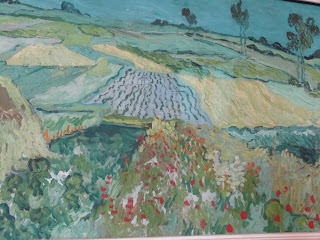
The next floors contained works from Vienna in the 19th century - namely works of classicism, romanticism, biedermeier, historicism, and impressionism. Famous works of Monet's such as Garden at Giverny, Van Gogh's Wheat Fields Near Auvers, Renoir's The Red-haired Bather, and Digas' Harlequin and Columbine are shown.Renoir's classical womanly figure was the epitome of beauty for the impressionists, and the landscapes depcted by both Monet and Van Gogh attempted at capturing the true essence of an experience or scene - realism was a top priority in their art. David's Napoleon Bonaparte also dominated one of the rooms, an example of the historicism which many artists desired to portray.

In the next rooms, there was a large collection of works by Gustav Klimt (his work The Kiss among them), Koloman Moser, Oskar Kokoschka, Egon Schiele, and Carl Moll. Klimt's works took up much of the exhibit. In all of his figure paintings, the woman's silhouette is outlined clearly and is positioned in the front; the man is always positioned in the back and he is less concrete and more abstract in form.

The Kiss was the only picture of people by Klimt which I liked - there was a tenderness there that was lacking in his other figures. However, his landscapes were very appealing. Their almost impressionistic style (more similar to pointillism) was beautiful, mixing blues and green into beautiful landscapes. Kokoschka's Prague Harbor was a combination between impressionist technique and the appearance of sketching. Schiele's focus on people with odd profiles and hardly any landscapes was definitely an form of expressionism within the modern boundaries.

Moser's Self-Portrait exhibited a direct use of color and purpose to communicate beauty through function rather that form. Finally, Moll's Twilight and Interior of the Winter Palace of Prince Eugene were created with an intense depth and meant to portray texture.

The final upper rooms were dedicated to the Biedermeier genre, where under Metternich's attempt at restoring the pre-Napoleonic years and implementing a conservative government through censorship and the secret police led to interior 'immigration'. The family unit was thus valued both at home and in art. Domestic scenes of the immediate family were in popular by the middle class during this time of urbanization and conservatism. Friedrich von Ameriling's portrait of a father and his three children remembering their mother is a perfect example of this notion of the closed family unit, as is Ferdinand Georg Waldmuller's Morning of Corpus Christi with the contrast between the peasants and the aristocracy manifested in the playing children. Finally, Josef Danhauser's Game of Chess was the first painting to represent life within the salons and illustrates the domestic nature of the Biedermeier period. The constant notion of the woman over the man is prevalent throughout the painting, with the woman standing and the man sitting; the queen of chess on the board; the woman winning the game; and the sculpture of Hercules enslaved to Omphale.

The entire Belvedere was quite large and overwhelming, but using the Wien Museum as a guide through each culture and artistic period of Vienna's history, the floors and paintings were easier to understand and comprehend.

I turned on the TV for the first time since being here in Vienna and was watching CNN (they don't have many English options over here...). Surprisingly, it wasn't much different from CNN back home - many of the same programs were aired, including interviews with Anderson Cooper and a special on the heros of Hurricane Katrina. The only difference seemed to be that there was a greater ethnic diversity among the channel's news broadcasters and that the commercials seemed to all be promoting or associated with the Arab world. There was not one commercial which did not try and promote a business in Dubai or did not deal with the region of Saudi Arabia. This is not as surprising as it may seem due to Saudi Arabia's wealth and obvious vicinity to Europe since Europe is its closes Western neighbor. It seems that for as conservative culturally and religiously as Saudi Arabia may be, it is definitely making a concerted effort to include itself among Western economies and business markets.

20 August 2010

Jewish Museum

Today after class we headed over to the Jewish Museum to try and see what we could learn about such an integral culture within Vienna. The museum's lower level had artifacts concerned with the various holidays throughout the Jewish year, including those relics used during temple services and associated with the Tabernacle. However, the second floor is where the history truly began.

The exhibit began with the expulsion of the Jews from Spain, where they fled to North Africa and into the Ottoman Empire. In 711 Spain was conquered by the Moors, but later the Reconquista pushed the Muslim influence out of the region. In 1492, Ferdinand and Isabella of Spain signed an edict expelling all Jews, participating in a mass ethnic cleansing. Some Jews fled to Portugal and then later to Amsterdam due to persecutions, and some established economic communities in the Balkans (parts of which were under the rule of the Ottoman Empire). These Sephardic Jews ('sepharad' is Hebrew for Spain) became assimilated into the Turkish empire, and were welcomed freely. When the peace treaty was signed between the Habsburgs and the Sublime Porte (referring to the Ottomans), Turkish citizens began to reside in Habsburgs lands, and Austrians began to settle in Turkish lands. Thus, due to these new cultural and economic relations, Sephardic Jews began to settle in Vienna. The Sephardic Jews became mediators between the east and the west, between orient and occidental, and between Asia and Europe.

In 1735 a treaty established the Turkish Sephardic Community in Vienna, but in 1830 the new Israelite law ended the community's autonomy, and they were incorporated into the Israelite community (The Association of Turkish Israelites).

Jews also settled in Bosnia (Sarajevo) after their expulsion from Spain, but with the establishment of the Yugoslavic state in 1918 and the subsequent German invasion , 75% of the Jews were sent to the Jasenovac Concentration Camp. The survivors after the war immigrated to Israel in 1948; only 1000 Jews remain today in Bosnia and Herzegovina.

When the Habsburgs were able to recapture Hungary from the Ottomans, there was a large influx of Ashkenazic Jews in Budapest, making the Sephardic Jews who had fled to Budapest now a minority.

The Ottoman conquest of Belgrade by Suleiman the Magnificent in 1521 led to an influx of Sephardic Jews in the city. Fights between the Habsburgs and the Ottomans over Belgrade continued until 1867 when the Kingdom of Serbia obtained complete independence. The Jews who fled to both Bulgaria and Thessaloniki were deported to concentration camps when the Germans invaded during WWII.

In Italy, the exhibition mentioned that attitudes toward the Jews were ambivalent and oscillating between acceptance and discrimination; the Republic of Venice was the first nation to implement a Jewish ghetto.

The Jewish musicians in Vienna were executed and exiled, and after the war, many refused to return to a land which had denounced and ignored their contributions to culture and history. As the exhibit mentioned, in exile they became a testimony to Vienna's past - while valued abroad they were only distantly remembered at home.

The exhibit itself focused mainly on the regional diaspora of the Jews after their expulsion from Spain, and did not detail the Holocaust. However, the second floor had a temporary exhibit of Ernst Toch, a classical and film score musician, who went into exile during WWII to avoid Hitler's wrath. The exhibit included more history from WWII, but was extremely modern with everything displayed on glass holograms and a mock pool patio as the backdrop.

Apart from the top floor, the Jewish Museum was extremely enlightening and gave a much needed and yet concise context for the Jewish culture in Vienna.

19 August 2010

Albertina

The Albertina is the best museum in Vienna, hands down. Today we decided to visit one of the only museums not required for class, the Albertina. In 1794 Emperor Franz II gave the palace as a gift to Prince Albert of Saxony (Duke of Teschen), the son in law of Maria Theresia, married to her eldest daughter Maria Christina.
It was extended and rebuilt several times to accommodate changing styles, including the building of the Habsburg statesrooms. These apartments were used as guest corridors when needed, with the Spanish room, built by Albert's heir and nephew Friedrich, being the only lodging for the Spanish Habsburgs outside of Spain. These rooms were emptied and damaged by the bombing in World War II, but recent renovations and conservation efforts have restored the rooms, complete with period pieces and tapestries.

Duke Albert was an avid arts collector and patron, and amassed a large personal collection, serving the higher purposes of 'education and the power of morality.' When the palace and staterooms where acquired by the Republic of Austria in 1919, more artwork of the Habsburgs was brought in, creating the current collection within the gallery today. However, since it is one of the largest collections of graphic and modern art, only small portions of its collection are shown to the public.
Pictures were only allowed in the staterooms, a practice I find unnecessary and pretentious since most Viennese museums do allow pictures, but the books in the gift shop had every piece within their collection showcased, so I didn't mind too much.
The staterooms were beautiful, housing sketches by Michaelangelo and paintings by Durer. However, the unique and grand architecture and design of the rooms was more impressive than the paintings the rooms contained. There was a rococo room, suited from ceiling to floor in yellow, the spanish rooms dressed in red velvet, the wedgwood room with blue and white wedgwood covering the walls, and so many more. Each room's theme was distinct and evident; there was even a grand ballroom with Greek statues framing each large window and mirror. The pastel watercolors and light marble walls and columns all gave off a sense of air and light, reflecting and continuing throughout the entirety of the museum.

The permanent collection went in order in terms of artistic styles throughout the period of modernity. The first room contained works by impressionists, neoimpressionists, and post-impressionists, such as Monet, Renior, Cezanne, Manet, and Van Gogh. These artists used color and movement to portray emotion and to convey a particular mood, with visible brush strokes and copious numbers of landscapes. The individual strokes aimed at catching the true qualities of an image or landscape, attempting at embracing realism. The neoimpressionist movement, especially, was highlighted in the gallery. Neoimpressionism was founded by George Seurat with contributions by Paul Signac, using the techniques of both pointillism (using small dots to form an image) and divisionism (using single dots of color to interact optically).
The next room contained works by the "fauvists," translated as wild beasts. This style grew out of Signac's pointillism, Cezanne's impressionism, and Van Gogh's post-impressionism, but was short lived, lasting only three years. The major artists showcased from this period at the Albertina were Henri Matisse and Andre Derain.

The expressionists were next, more radical and sexually provocative than the fauvists. These expressionists belonged to the German group Die Brucke, wishing to convey an inward experience of the world. Works by Nolde and Pechstein were showcased in the gallery. Another group closely associated to the expressionist movement was Der Blaue Reiter, a German group of artists from Munich, among them Paul Klee and Lyonel Feininger. This group was inspired by orphism (abstract uses of bright color) and cubism.

As a side note, we were talking in class recently about Arnold Schoenberg and how he was an Austrian composer associated with modernism and expressionism. His classical compositions do have a logic to them much like expressionistic art, and one can tell that he hears the logic and hears a magic that is not readily heard by everyone else in his music. For me, I don't mind his music, but I also don't prefer it over other classical composers. It seems like it should match a film score or a silent film more than it suits an orchestra and its audience.

The Russian Avant Garde room followed, in which Marc Chagal's works were the most prominent. Chagal's vivid and colorful paintings in turn anticipated (both historically and literally) the surrealism presented in the next room. Works by Joan Miro, Max Ernst, and Rene Magritte were all showcased, mixing the unreal with the real. The last few rooms contained paintings and works of the cubists, such as Picasso, who took particular aspects of an image and reinterpreted (or analyzed) them. Later in the cubist movement, these separated aspects of an image were again reunited in the manner of a collage-style painting.

The museum as a whole was absolutely astounding. The major works in the permanent collection are a recent acquisition by the museum, given over by the Batliner family who are avid art collectors.

Today's German Word:
Moglich - 'possible'